

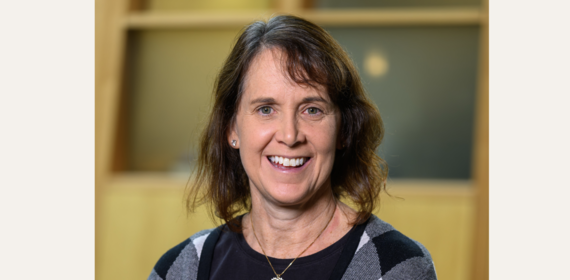
In Dialogue with Robin Dillon-Merrill
Robin Dillon-Merrill is a Professor and the Operations and Information Management Area Chair at the McDonough School of Business. Spanning topics such as NASA mission management, natural disasters, terrorism, and more, her scholarship, teaching, and experience have focused on uncertainty, risk, and decision-making under these conditions. She has served as a risk analysis and project management
expert on several National Academies Committees, the co-chair of the Georgetown Environment Initiative, and the NSF Program Director for the Humans, Disasters, and the Built Environment program in the Engineering Directorate.
Francesca Hales is a Georgetown Global Cities Initiative Student Research Assistant. She is a senior in the CAS majoring in American Studies.
FH To start, let’s talk about your recent involvement with GGCI through your overseeing a student project with the DC MID (DC Mobility Innovation District). Can you discuss the project and how it came to be?
RDM One of the things that all of my research projects have in common is they’re around system dynamics and the need to understand everything at play in a system to really understand decision-making. My collaboration with Uwe Brandes has been around sustainable systems. On the face of it, decisions may seem fairly simple, but when you start digging into them, you understand that there are more complex systems behind them.
With the micro-mobility project, Ian and her colleagues had this great idea to create a lending library for e-bikes. They got a grant and bought some e-bikes, and then that's when the system really kicked in. What they learned from their pilot is that you need to do more than just have the bikes, you need to invest more in the whole system.
They may have had grants to buy the bikes, but then somebody still has to maintain and repair them, and there needs to also be some kind of ongoing support. I think it was really interesting for the students to learn from it, and for Uwe Brandes, the Southwest Business Innovation District folks, and me to learn from it too.
FH So this micro-mobility project has been shown as a promising solution in Southwest and the Capitol Riverfront. But how do you feel about the scalability of similar projects as urban transportation solutions and their applicability to other cities in the U.S. and beyond?
RDM Generally, we were only looking at a slice of micro-mobility, just this e-bike and cargo bike lending library, and so one of the things that we pretty quickly grappled with was your point: where does this fit relative to other micro-mobility efforts like Capital Bikeshare? Is this a competitor? Should CaBi be doing it? Who is the audience and why is this helpful?
We did a lot of the outreach to lower socioeconomic status folks for whom CaBi or other micro-mobility could end up cost-prohibitive to understand what we were really trying to solve. We found that while these bigger-scale micro-mobility efforts fill a particular gap, there are still more pockets of gaps left over. We went in assuming that micro-mobility is important and that Lime scooters and CaBi share are a given,
and then we started to look at what other pockets are still missing beyond them. With micro-mobility, we absolutely agree it is important, and we recognize some big efforts are already addressing many of its challenges, but that there are still pockets and gaps in it.
FH Beyond your involvement with this project, could you expand on how your past research interests have intersected with cities and planning?
RDM One of the things that I collaborated with Professor Brandes and our other colleague Evan Barba on earlier in the summer was a workshop called the “Systems of Vacancies” where we looked at the challenges with the the commercial real estate market in Washington, D.C. It's not just Washington D.C.’s problem, it’s something happening in cities across the country.
My personal opinion is that the system has made it far too easy for commercial real estate to be the obvious investment. It's basic supply and demand economics where people will do things that will make them money. At least in Washington, D. C., the easiest way to make money was with commercial real estate. That's the system and all its factors were driving people that way, so we ended up with way too much of this
type of real estate, something we need to take a new look at.
Related to that, Georgetown is somewhat taking advantage of the commercial real estate market by buying up buildings and expanding its presence downtown. Another thing that I'm collaborating with Professor Brandes on is trying to understand what the challenges in the area are, who the stakeholder groups are, and how university research can help have a positive impact.
FH Honing in on your background in risk analysis, I am curious about your
take on urban risk management. What are the unique challenges associated with
risk analysis and management in global cities amid rapid urbanization?
RDM What I would point out as most relevant for cities and risk certainly is all of the decisions that we recently saw around the pandemic and how those dynamics will translate to the next big challenges.
I think that in some of the major cities with democratic leadership, we deferred a bit too much to the public health people and weren't willing to look at the real risk trade-offs. Nothing is black and white, and there are always pros and cons.
Risk management comes into play as we look at which trade-offs we are and aren’t willing to live with. We can see recent examples of the challenges in urban risk trade-off decision-making around laws strengthening or weakening penalties for different crimes for example. Future decision-makers will be facing these kinds of tough challenges and need to really consider where to make these kinds of trade-offs.
FH Finally, what's next for you? Are you going to continue diving into city-related topics? Do you have any other projects on the horizon you want to highlight?
RDM Right now everybody's talking about generative AI. What I've always been looking at is how people interpret and understand things, and in the past, we've had various methods to try to investigate people’s behavior during hurricanes and things like that. In terms of what's next, I will be looking at how we can use these tools to get more information out of some of our existing data. The more you start talking to
people, the more you see how overloaded they are by their quantity of data. There is so much potential for generative AI to go into all of this data and understand the messages and what the data is trying to show you.
In a city with non-emergency reporting systems, for example, if the systems are working well, they should be generating enormous amounts of reports and data. There's potential for generative AI tools to be able to understand all the information coming in and turn it into something we can handle and manage.
As we get more and more data, there are new opportunities to use it. But we have to understand where the data is coming from, what the algorithms are predicting, what the risk trade-offs are, and what the overall system is. That's one of the things that is going to keep me interested.
FH It was a pleasure chatting. Good luck with your upcoming projects.