

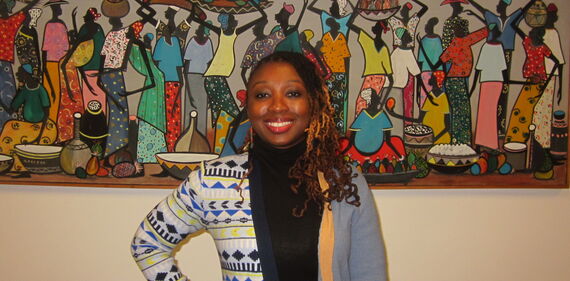
In Dialogue with Prof. Titilola Halimat Somotan
Dr. Titilola Halimat Somotan is an Assistant Professor in the SFS. As an urban historian, much of her work focuses on decolonization, urban history, and postcolonial rule, delving into the roles of diverse actors and everyday people in shaping cities. Some of her recent publications focus on housing demolition in Lagos and contested public cemetaries in Lagos. This interview was conducted by Francesca Hales, a GGCI Student Manager and rising senior in the College of Arts and Sciences.
Francesca Hales You’re an urban historian, but one of the themes in your work is urban futures. In planning for future cities, how should people draw on history?
Titilola Halimat Somotan It's important not to just begin from the place of problems, but to first ask: how did this place come to be? From the planning perspective, there's often an emphasis on solving problems, which can blind you to the complexities of how issues emerge. Historians understand you can’t draw a straight line from the past to the present.
In terms of urban futures, history can help us think about other forms of solutions that have been overlooked or even discarded. Through colonization, many things that were normal and helped people to coexist with the environment were often deemed backward, primitive, and not modern.
A basic example of this is using mud to build houses. It comes from local ground and keeps heat down through insulation, unlike the hot brick and corrugated iron houses the British considered "modern." So the adoption of these brick and iron houses created a different future for Nigeria.
We are living in a very specific kind of future right now, but that shouldn't blind us to the fact that other forms of the future have been cut off. We should ask: what can the past teach us about what we're trying to do today? And what other possibilities are we blind to?
FH African cities like Lagos occupy a huge presence in contemporary discourse around global cities. What are your thoughts on the idea of African urban futurism?
THS There are many different ways to read the discourse of “we should now pay attention to African cities.” Sometimes it reads like we should care not because of what we can learn from people who live there, but because of what we can get from them. It sometimes seems wrapped up in the language of exploitation and discovery, rooted within the sense of colonialism. And it is tied to whether or not we consider these cities as part of the urban experience, much more globally. Sometimes “global” is a siloed understanding of globality, rather than a real reflection of the ways that we are connected together.
But I can also understand why some people write pieces to highlight the demographics and help spotlight the people who live in these cities. On one hand, it's important that there's attention given to these spaces. But we need to ask ourselves why we are just now spotlighting these places when for decades and centuries, they've been urbanizing.
We need to expand our understanding of globality. We should ask what other cities can teach us about living within our spaces. When thinking about why these cities are important, it shouldn't be just about the numbers, but about the people.
FH Much of your work has delved into different facets of urban life in Lagos. What are some of the lessons or takeaways from your extensive study on this place?
THS At the core of my work is a focus on the ideas that everyday people can teach us about alternative ways of planning cities. One of the main issues that Lagos grapples with is: who has a place and the ability to live in the city?
In Lagos, for example, a key issue has been housing demolition as low-income people are displaced so their neighborhood can produce more profit and serve more affluent people. These actions move us away from the bigger question of how we can make the city more affordable and livable for everybody. The people contesting the demolition are pushing policymakers in that direction and challenging the coloniality of why we even have housing demolition in the first place.
I also try to think about Lagos from different spaces that are not often centered in the field, like with my cemetery piece. I investigated how people save the spaces that mean so much to them, the spaces that have defined people's identity and ties to the city, and how everyday people can be in charge of defining those policies.
These are some of the discourses that interest me because they go back to the core of understanding everyday people as central key players in the process through which cities change.
FH Looking ahead, what are you curious about and inspired by right now?
THS The big thing for me is my book. It's situated in the history of decolonization in Nigeria and post-independent Nigeria. I’m asking: for people undergoing this transition process, what kind of demands are they making for policies to make the city more livable? I’m looking at policies on housing, policies on infrastructure, and even political representation.
I'm working on oral interviews, and it's been super exciting to hear from the perspective of people who grew up in 1940s-70s Lagos, hearing what the city meant to them and reconstructing the past through their memories. I’m also using novels, administrative sources, and more. All of these sources open up new worlds for me. There's an endless amount to unpack, even within one city.