

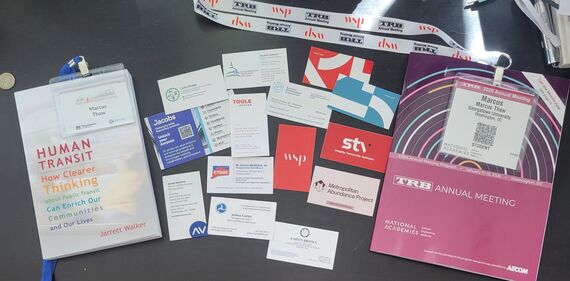
DC's Annual Global Summit on Transportation Research
Marcus Thaw is a masters candidate in the Georgetown Urban & Regional Planning Program (MURP ’26). Marcus attended the 105th annual TRB, which took place in Washington, D.C. from January 11-15, 2026. This article summarizes his reflections and provides insight into what actually happens at a global research summit.
The Transportation Research Board Annual Meeting (“TRB”), organized by the National Academies of Sciences, Engineering, and Medicine, is the largest convening of transportation professionals in the United States, bringing together thousands of researchers, public-sector practitioners, consultants, and policymakers each year in Washington, D.C. The conference serves as a central forum for sharing research, trends, challenges, and shaping the future direction of transportation policy and practice across all modes. Over the course of a week, TRB blends formal research presentations with workshops, committee meetings, and poster sessions while providing the forum to elicit informal exchanges that collectively influence how transportation systems are conceived, planned, funded, operated, and governed at local, state, and federal levels.
On the Ground
TRB is often described as a research conference, and while that’s an incomplete portrayal, it is accurate and important to remember. The program spans everything from asset management best practices and related software to governance, street design tradeoffs, and particular asphalt mixture makeups and guidance on their inspection. Attendees range from PhD researchers to transit operators, government staff (mainly DOTs), and consultants across the spectrum of responsibilities and project type. (TRB Annual Meeting | Schedule)
What surprised me most (even on Day 1 of a weekend-starting conference) was the energy and high number of participants. The day’s sessions I attended focused on workshops so as not to exclude those unable to join on a weekend from the juicier topics or requisite work that happens during committee meetings. This strategic scheduling also benefitted participants by immediately shifting everyone into problem-solving mode instead of passively consuming presentations. For me, this was a perfect use of the brilliant minds in attendance before they would be tired by a week of literally non-stop meetings, networking, happy hours, lack of sleep and exercise, and exclusive subsistence on restaurant food.
My Program
As you can see, I packed in a ton of sessions, and this doesn’t include the dozens of posters I viewed! It’s hard to comprehend just how is available. I also attended the TRB Career Fair on the first day - The footprint was smaller than I expected given TRB’s scale, but it was still valuable, particularly speaking with representatives from firms that I already had network connections with, greasing the wheels of those conversations. For students, it’s worth treating the Career Fair as one component of networking rather than the main event: TRB’s real professional value is distributed across the entire week through sessions, hallways, receptions, and committee meetings. Note before reading: My big picture overview may be slightly biased as evidenced by the sessions I attended being about land-use, micro-mobility, and mostly trains.
State of the Industry
2026 revealed an industry at a crossroads, needing to determine a clearer path forward to address myriad challenges. Like many sectors, transportation professionals are moving from the “head-down number-crunching” of the early 21st century toward a more holistic approach to planning that still recognizes the immense power modern data analytics. Depending on the room you’re in, you might not know that public transit even exists because of the sheer quantity of oxygen consumed by car and road content. The promises that "unleashed innovation" will lead to the autonomous vehicle (AV) revolution and solve our safety crises abound. And a quick glance at TRB’s program might convince you Artificial Intelligence (AI) is the only sure-fire way to reserve a room to present your academic research.
Business as usual has led to all forms of transportation being underfunded. As mentioned above, North Carolina DOT’s (NCDOT) representative on a panel explained their state’s innovative approach by bringing all the modes together to aim for overall transportation goals unlike typical state DOTs where modes operate in siloes that rarely interact until a conflict arises. Instead, this creates a single ecosystem where all modes work toward statewide, unified goals. This method appears similar to the model recently implemented at DC’s RFK redevelopment with the Director of the Department of Buildings (DoB) being appointed as Project Executive. No longer does each mode need to promote its own technology (and fight for a bigger pot of money). Now the focus is on achieving broad institutional objectives. This type of integrated governance is becoming a prerequisite for the holistic coordination necessary for today’s complexities.
Finally, while the industry faces a softening freight market and the expiration of IIJA funding, the narrative around rail has evolved from a simple argument of absolute advantage due to fundamental laws of physics to a different kind of physical law: one of "gravitational pull" for regional economic development that enhances connectivity. This benefit while also telling everyone what they want to hear: “it will relieve traffic congestion” by taking trucks and people off the roads.
The industry is increasingly framing passenger rail not just as a transit mode that offers freedom a la Jarrett Walker, but as a central catalyst for commercial, retail, and tourism activities, as well as a critical driver for housing density; again, without the congestion-that’s very important to people. This "rail revival" is underpinned by consensus gained that transit-oriented development provides long-term real estate and market stability. As planning moves beyond just "counting cars and walkers" to determine street widths, the focus is shifting toward the surrounding context—using rail and mass transit as the anchor for safety and comfort-focused urban and regional environments that can withstand the fiscal and demographic pressures of the coming decade.
Plus, plenty of evaluation of and discussion about the first full year of congestion pricing in New York City! Findings: Smashing success!
Governance is the hidden engine of delivery and ongoing success
If I had to pick my one word of the conference, it would be ‘governance.’ During my favorite three sessions, one on passenger rail delivery, another on high-speed rail multi-modal stations, and transit fiscal sustainability, the technical content was rarely the limiting factor to success. The hard problems were about roles, responsibilities, and decision-making authority, especially when ownership and operational control are fragmented.
In a panel discussion focused on turning passenger rail goals into plans, speakers described how difficult it can be to align objectives when multiple agencies, operators, and political actors share pieces of the same system. It was during this session that NCDOT emphasized their “umbrella” approach intended to avoid favoring one mode over another. Another session coalesced around themes describing the people and coordination challenges for projects when they move from vision to implementation.
The storytelling gap has real impact on funding
Several sessions reinforced something planners feel instinctively: data alone does not secure public trust or political permission. In a session on transportation, land use, and economic development, presenters noted that while the benefits of integrated planning are widely understood within the profession, agencies still need better narratives and more transparent evidence to communicate value to the public. Even if data were enough, a lot is proprietary, further straining the job of practitioners to persuade the public.
A recurring frustration across the week was not “lack of analysis,” but lack of translation: how do we connect investment to outcomes people recognize? How do we convey benefits that accrue across jurisdictions or over long time horizons (especially when election cycles are short)? How do we talk about projects that create access to jobs that may not be “created by transit,” but become reachable because the system changes?
For urban planners, this is familiar territory. We are often responsible for the narrative glue that connects a technical solution to a civic story: not just what is being built, but why it matters, who it serves, and how tradeoffs are managed. TRB echoed what our professors often push - that this is not a soft skill but a prerequisite.
TRB’s Importance
The event has immense gravity, pulling thousands from around the globe to attend. Plus, there are even more folks that come to town to network even without attending the conference itself. Professional organizations, associations, and individuals that benefit from proximity. My biggest takeaways from TRB did not happen at microphones but between sessions and after hours at happy hours where people speak more candidly - shoutout to Dacha for hosting three straight days of transportation HHs!
That is exactly why the conference remains so valuable. If planning is meant to prepare practitioners to operate across institutional boundaries, then we need consistent exposure to the forums where those boundaries are negotiated in the first place.
It also reinforced something I have increasingly come to believe: the future of transportation depends less on a single technology and more on people—professionals who can think holistically, communicate clearly, and coordinate across fragmented responsibilities, even when conditions are uncertain.
Looking ahead: bringing TRB back into the classroom
I left TRB with connections to numerous practitioners and researchers willing to contribute to my capstone work on Washington Union Station and a broader, stronger career network overall. More importantly, I left with renewed appreciation for the role planning plays in transportation and real-world implications beyond the academic. For Georgetown, TRB is one of the clearest (and closest) windows into the evolving transportation profession where the program’s relevance is reaffirmed and relationships can be built for collaborating and presenting.
I am grateful every year for the opportunity to attend because I enjoy learning so much! I hope these reflections help demystify TRB for other students and practitioners who may consider it in the future. If you read this and have any questions about TRB, the transportation industry, Georgetown’s planning program, or any other curiosities, do not hesitate to reach out to me at Mct117@georgetown.edu